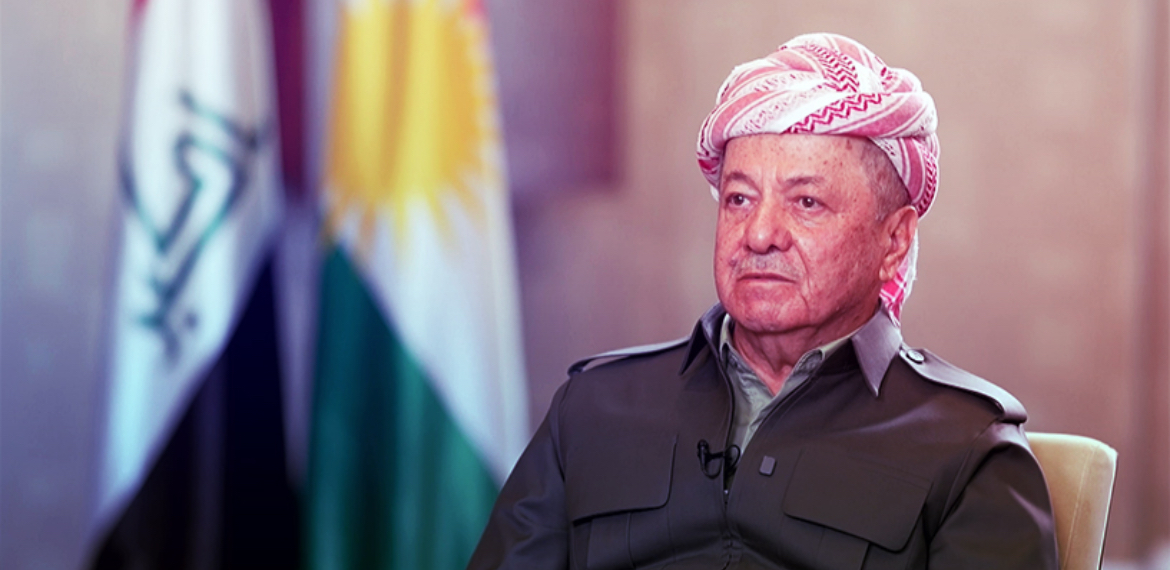
Kurdistan Democratic Party leader Masoud Barzani delivered a series of political messages during a television interview with Al Sharqiya, conducted by journalist Hisham Ali, addressing the future of Iraq’s political process, relations between Baghdad and Erbil, the weapons issue and the withdrawal of international coalition forces.
Barzani stressed that Iraq’s political system should be built on partnership, balance and consensus, arguing that these principles are essential to protecting the rights of all communities. He criticized the way successive Iraqi governments have handled political agreements, saying that commitments are often set aside after governments are formed, while constitutional provisions are also disregarded, leaving political decisions vulnerable to personal interests and positions.
The KDP leader discussed the disputes that accompanied the formation of the current government, claiming that his party had been subjected to what he called a “dirty conspiracy” involving some Coordination Framework factions and representatives of the Sunni component.
Barzani also revealed details of an agreement reached between Kurdistan Region President Nechirvan Barzani and Badr Organization Secretary-General Hadi al-Amiri, saying the agreement has still not been implemented. He questioned the purpose of Kurdish participation in a government that, in his view, does not adequately protect Kurdish rights and dignity.
Addressing attempts to sideline the Kurdistan Democratic Party, Barzani rejected the possibility of excluding the party from Iraq’s political scene. He said those who believe the KDP can be pushed aside are mistaken, arguing that political forces may change over time while the party will remain present.
Barzani also said that governing Iraq without the Sadrist movement and the KDP leaves the political system lacking balance. He held the Coordination Framework responsible for what he described as failures to honor political agreements and understandings.
On the issue of weapons, Barzani said bringing all weapons under state control would be extremely difficult in the near term, pointing to groups that benefit from maintaining weapons outside state institutions. He warned that the continued presence of weapons beyond state authority could expose Iraq to serious crises and unpredictable consequences, stressing that all political actors are ultimately “in the same boat.”
Regarding the international coalition, Barzani warned of the possibility of a repeat of the ISIS experience following the withdrawal of international forces and urged political actors not to turn the issue into a source of political rivalry.
He recalled that Iraqi political leaders had decided in 2011 to end the U.S. military presence, but returned after the emergence of ISIS in 2014 to seek assistance from the United States and other countries in confronting the group, saying that experience should be taken into account when discussing the future of the international presence in Iraq.